
In the television version of podcasting, all you need is a microphone, a compelling mystery and somewhere vaguely intimate to sit.
Three amateur sleuths can squeeze into a Manhattan cupboard, press record and, before long, acquire a sponsorship deal while solving a murder. Two sisters can sprawl on a sofa, microphones in hand, gossip about their sex lives and somehow end up negotiating a multimillion-dollar contract with Spotify.
It is a seductive fantasy. It is also, for the most part, nonsense.
Over the past decade, series including Only Murders in the Building, Truth Be Told, Bodkin and Nobody Wants This have turned the podcaster into a curious modern folk hero: part journalist, part detective, part accidental celebrity. Armed with little more than a smartphone and an instinct for a good story, the fictional podcaster investigates cold cases, exposes wrongdoing and acquires an audience almost overnight.
The real podcast industry is rather less glamorous. There are scripts to write, interviews to research, rooms to treat, microphones to position, levels to monitor, hours of audio to edit, noise to remove, episodes to mix, feeds to publish and audiences to build. None of this makes especially compelling television.
A new academic study suggests that the gap between the two worlds is not merely one of dramatic licence. It is structural.
The peer-reviewed paper, La representación del podcasting en las series de ficción: el perfil del podcaster y rutinas de producción (“The representation of podcasting in fiction series: podcaster profile and production routines”), published in Revista Comunicación, examines 85 episodes of television made between 2019 and 2024, a period in which podcasting moved from niche curiosity to established media industry.
Its authors, María Fitó-Carreras of the Universitat Internacional de Catalunya and Alfonso Freire-Sánchez of the Universidad Abat Oliba CEU, conclude that television has constructed an image of podcasting that is technically, organisationally and sometimes acoustically implausible.
“Fiction is building an image of podcasting that is, at best, a crude simplification, and at worst, a fantasy flatly incompatible with the physics of sound,” Fitó-Carreras argues.
The result, she says, is that professionals are left having to explain that podcasting is a craft rather than simply “sitting in front of a microphone and talking”.
The fantasy that anyone can do it
There is, of course, something genuinely democratic about podcasting. Unlike traditional broadcasting, it has few barriers to entry. Anyone with a recording device, an internet connection and something to say can publish.
That is one of the medium’s great strengths.
Television, however, has taken that accessibility and quietly turned it into a fantasy of effortless competence.
According to the study, half of the podcasters portrayed in the fictional series examined are amateurs with no apparent training, experience or specialist technical knowledge. Yet they routinely produce immaculate audio, attract large audiences and behave as though the complicated machinery of professional production simply does not exist.
The distinction matters. Making a podcast is easy in the same sense that writing a novel is easy: the tools are accessible. Producing something consistently good is another matter.
Spanish producer Francisco Izuzquiza captures the irritation felt by many professionals. “Mucha gente piensa que hacer pódcast es ponerse delante del micrófono y hablar,” he says. Literally. If there were not such widespread ignorance about the work involved, he suggests, the idea would sound almost insulting.
Independent producer Jay Cockburn puts it more gently: “Podcasts are easy to make, right? Sort of.”
That “sort of” is doing a great deal of work.
The fictional version of podcasting treats expertise as optional. Characters with journalistic or broadcasting backgrounds may possess useful skills, but the implication remains that technical competence can be conjured from enthusiasm. The microphone becomes less a piece of equipment than a narrative prop.
The microphone is not a magic wand
The problem becomes harder to ignore when television starts showing people actually recording.
In Truth Be Told, Poppy Parnell records in a dining room, with the microphone positioned at a distance that would make clean, controlled vocal recording difficult. In Nobody Wants This, hosts hold microphones in their hands while sitting on a sofa – a visually appealing arrangement that would also introduce the kind of handling noise an audio engineer spends considerable effort eliminating.
Then there is Bodkin, in which reporter Gilbert Power travels around rural Ireland recording interviews with a portable recorder and external microphone. He does not, apparently, need headphones.
In reality, monitoring is one of the least glamorous and most indispensable parts of field recording. Without headphones, a producer may not discover wind noise, distortion, clipping, interference or a bad microphone connection until the interview is over – precisely when there is nothing left to do about it.
The study also identifies a more fundamental problem: the rooms.
In three of the four series examined, characters record in large, open living rooms or kitchens. These spaces look excellent on camera. Acoustically, they are hostile territory. Bare walls and hard surfaces reflect sound, creating reverberation that can make speech muddy and difficult to edit.
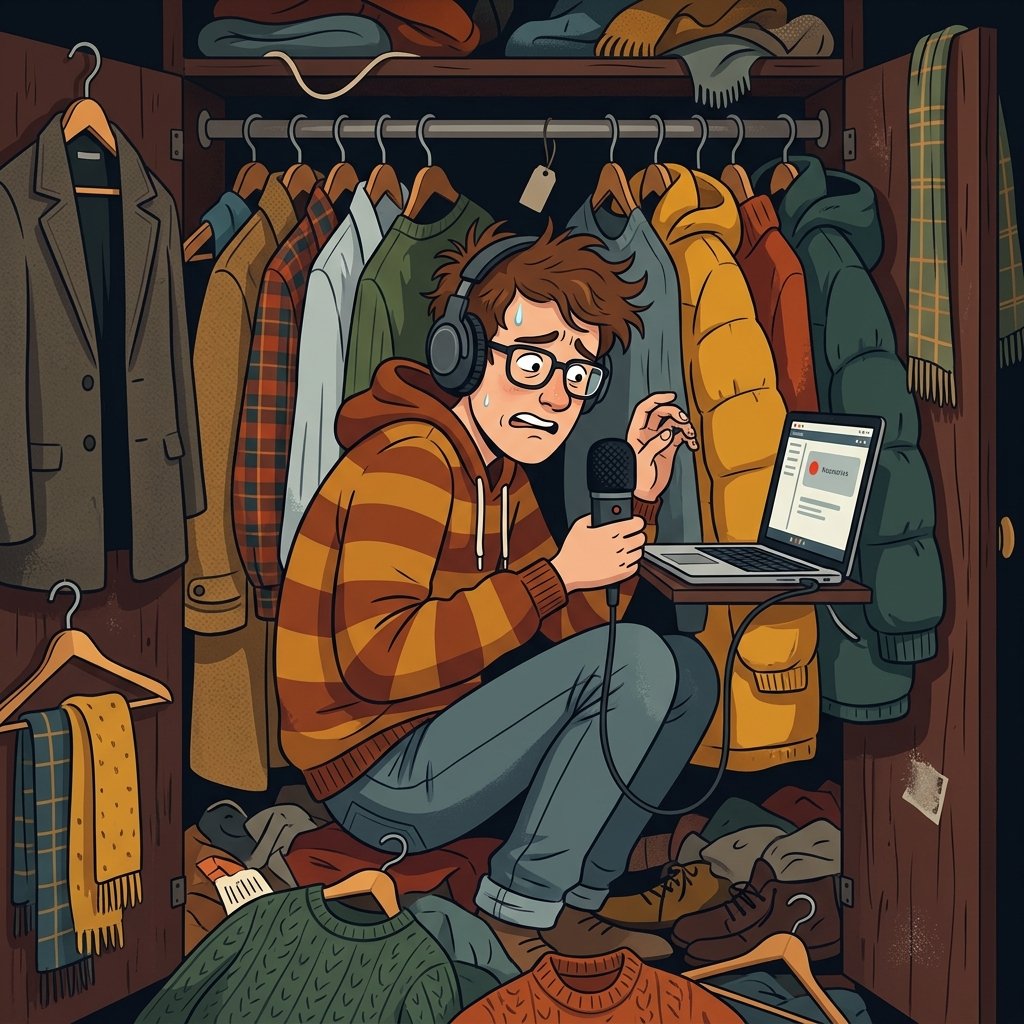
The paradox is that Only Murders in the Building, perhaps the most technically playful of the shows, gets some of the equipment closer to reality. Its characters use directional microphones and boom poles.
They then retreat into a cupboard.
The cupboard, it turns out, is doing the work of a studio.
There is a kernel of truth here. Clothing can absorb some high-frequency reflections and reduce flutter echo. But a wardrobe is not a recording studio. It provides no meaningful soundproofing, offers uneven absorption and can produce the boxed-in quality familiar to anyone who has recorded in a small, heavily furnished space.
It is an emergency solution, not a production philosophy.
The work television would rather not show
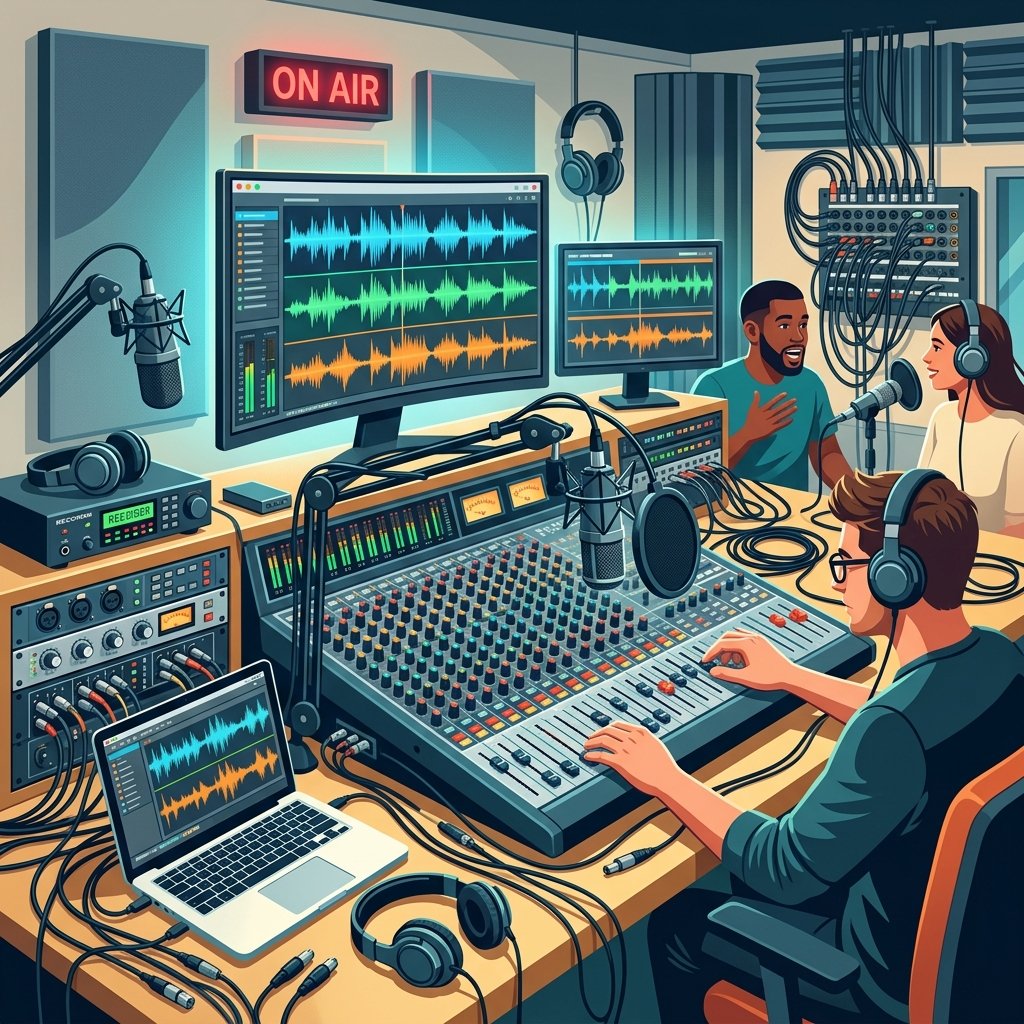
The biggest distortion is not what television gets wrong about microphones. It is what television chooses not to show at all.
The researchers divide podcast production into six stages: pre-production, recording, post-production, publishing, commercialisation and promotion.
Recording appears in every one of the fictional series. Pre-production appears in three-quarters. Commercialisation appears in half. Publishing appears in a quarter.
Post-production and promotion appear in none.
That is quite an omission.
| Production phase | Representation in TV fiction | Importance in real-world podcasting |
|---|---|---|
| Recording | 100% | Critical, but represents only a fraction of the total production process. |
| Pre-production | 75% | Essential for research, scripting, narrative design and planning. |
| Commercialisation | 50% | Vital to the sustainability of independent podcasts, though often simplified on screen. |
| Publishing | 25% | Involves technical processes such as metadata, hosting and platform distribution. |
| Post-production | 0% | Includes dialogue editing, noise reduction, mixing, mastering and sound design. |
| Promotion | 0% | An ongoing requirement involving marketing, audience development, social media and community management. |
The 0% for post-production and promotion is probably the most revealing finding: television repeatedly shows people recording podcasts, but almost never shows the substantial labour required to turn those recordings into something publishable — or the even harder work of getting anyone to listen.
Editing raw audio into a coherent programme can take hours. Dialogue has to be cut and cleaned. Pauses need judging. Levels have to be balanced. Background noise may need removing. Music and effects must be placed. Transitions have to work. The final mix has to be checked.
And then there is the audience.
Television’s fictional podcasters seem to exist in a world in which publishing an episode is equivalent to marketing it. They upload the file and, almost immediately, people listen.
Real audiences are less obliging.
Podcasting is now an intensely crowded market. Discovery requires promotion, social media, clips, newsletters, collaborations, advertising, community building and persistence. An excellent programme can disappear without trace. A mediocre one can become enormous. Neither outcome is particularly cinematic.
So television skips the boring bits.
That is understandable. It is also consequential.
The podcaster as journalist
There is another, subtler distortion: television’s tendency to turn the podcaster into a journalist.
In three of the four series examined, podcasting is closely associated with traditional journalism. Truth Be Told gives us Poppy Parnell, an experienced journalist. Bodkin centres on Gilbert Power, a radio reporter. Even the amateur hosts of Only Murders in the Building are driven by an unmistakably journalistic impulse: the desire to find out what really happened.
It is an old Hollywood archetype in new clothing. The investigative reporter has been replaced, or at least supplemented, by the podcaster.
The story structure is familiar, too. Curiosity becomes obsession; investigation becomes personal; the search for truth damages relationships. In Truth Be Told and Bodkin, professional investigation carries an intimate cost, including the collapse of marriages.
There is good drama in this. But it risks confusing two very different things.
Podcasting is a medium, not a profession.
Some podcasts are investigative journalism. Others are comedy shows, interviews, fiction, conversation, criticism, education, personal storytelling or little more than people talking about their week. A microphone does not confer journalistic status.
That distinction matters because journalism comes with obligations – verification, attribution, accountability and, in serious reporting, an ethical framework. A conversational podcast does not automatically acquire those responsibilities simply because a television drama gives its host an investigative storyline.
As the researchers put it, fictional series may help audiences understand aspects of podcast production, but their representation is frequently inaccurate.
Why the fantasy matters
It might be tempting to dismiss all this as pedantry. Television routinely gets professions wrong. Doctors perform impossible procedures; journalists discover evidence in time for the final act; detectives solve murders by staring meaningfully at photographs.
Why should podcasters be any different?
Because fictional representations do not merely entertain. They establish expectations.
“The way podcasting is represented isn’t neutral. It shapes expectations,” Fitó-Carreras says.
That creates what might be called an expectations gap. An aspiring creator watches a fictional podcaster produce a successful show from a living room and assumes that the barrier to entry is essentially a microphone. They discover later that the real barriers are not necessarily expensive equipment, but time, technique, editorial judgement, acoustic knowledge, persistence and the ability to find an audience.
Some will learn. Others will give up.
The irony is that television has done something both useful and damaging to podcasting. It has made the medium culturally visible while making the work behind it invisible.
That is perhaps the inevitable fate of any craft whose most important labour happens off camera. The finished product sounds effortless. The hours required to make it sound that way are precisely what the listener is not supposed to notice.
Hollywood understands the first part perfectly.
It is the second that podcasting’s professionals may have to keep explaining.
Quick Answers: What the television microphone leaves out
Why do professional producers wear headphones?
Because microphones hear things people do not. Live monitoring allows producers to detect distortion, wind, interference, handling noise and other problems while there is still time to fix them.
What is handling noise?
It is the vibration and mechanical noise transmitted to a microphone when it is touched or moved. Holding a microphone while sitting on a sofa may look natural. It is also a good way of introducing unwanted noise into a recording. Professional setups therefore use stands, boom arms, shock mounts and other forms of isolation.
Can you record in a cupboard?
Yes. Should you build your production workflow around one? Probably not. Clothes can absorb some sound reflections, making a cupboard preferable to a bare kitchen in certain circumstances. But absorption is not the same as soundproofing, and small enclosed spaces can create their own acoustic problems. The wardrobe is a trick. It is not a studio.