

GANDHINAGAR: In audio storytelling, the “tape”—the raw, crackling sound of a protest or the tearful confession of a witness—is often called king. But if the tape is king, the script is the architect who built the palace. Without a sharp, intentional script, a podcast is just a collection of sounds.
To move a listener, a writer must move beyond “delivering facts” and embrace the mechanics of literary nonfiction, structural momentum, and sonic braiding.
The Power of the First Image: Noble
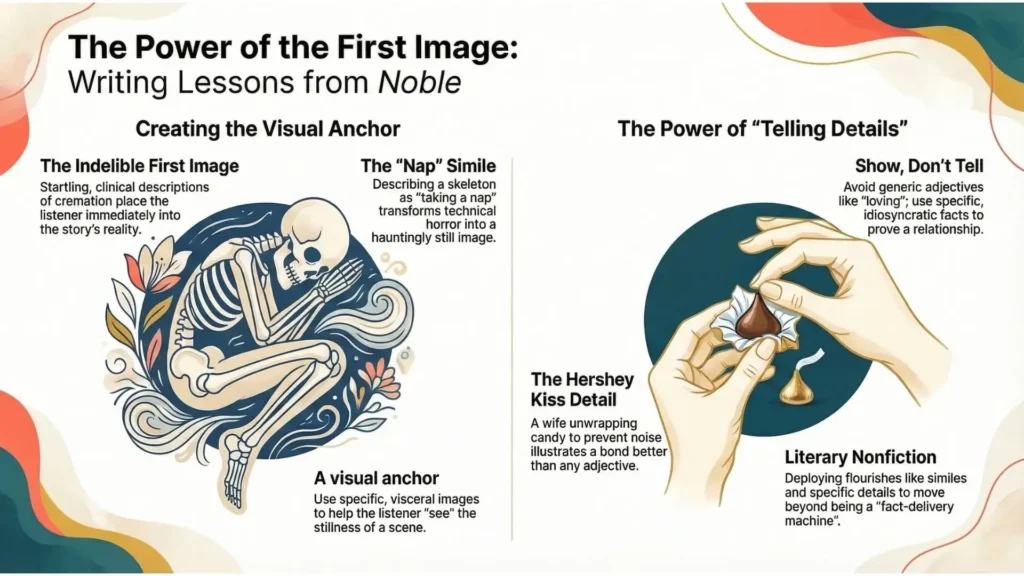
In the podcast Noble, writers Shaun Raviv and Johnny Kauffman investigate a horrid discovery at a Georgia crematorium. They avoid the cliché of a slow introduction, opting instead for an indelible first image that is both clinical and visceral. …Listen
The script opens: “It takes 28 gallons of fuel and a spark to burn a human body. The body lays flat for hours, engulfed in flames… as hot as molten rock”. It’s a visual anchor. By the time Raviv narrates, “When the furnace is turned off, only a skeleton remains, laying prone. Like it decided to take a nap,” the writer has used a simple simile to transform a horrific technical process into a haunting, still image. That “nap” is a tool that helps the listener “see” the stillness of the scene.
Good writing also breathes through “telling details”—the specific, idiosyncratic facts that prove a relationship. When profiling a victim named Ira and his wife Sheila, the writers could have simply said they were a “loving couple.” Instead, the script reveals that Ira was a “Hershey Kiss nut” who hated the sound of rattling foil while hunting. The script records Sheila’s memory: “The night before, I would sit there and unwrap each of those individual Hershey Kisses and put them in a Ziplock bag for him”. That single image of a woman unwrapping candy for her husband tells the listener more about their bond than ten minutes of adjectives ever could.
Killing the Recap: The Pig Iron Handshake
One of the most common failures in serialized audio is the “Previously on…” montage—a repetitive crutch that stalls momentum. In Pig Iron, a series investigating the death of journalist Christopher Allen, writer Basia Cummings utilizes what is known as the “episode handshake”.
Instead of looking backward, the script for Episode 5 propels the listener forward while naturally weaving in the necessary context. Episode 4 ends on a cliffhanger: will the team trust a mysterious, increasingly hostile source and fly to Kenya to meet him?
The script for the next episode begins not with a summary, but with the roar of a jet engine. Cummings narrates: “We’re about an hour and a half away from Nairobi. We’re actually right over South Sudan now… and we’ve just hit some turbulence”. By placing the listener on the plane, the script answers the previous episode’s question (did they go?) through action rather than explanation. It recaps the stakes—the “mysterious author” and the “years of investigating”—without ever making the “binger” feel like they are hearing the same story twice.
Braiding Sonic Textures: Leila Fadel’s Syria Reports
The most sophisticated audio writing feels “musical,” a quality achieved by braiding narration, scene audio, and interviews into a seamless flow. Leila Fadel’s reporting for NPR on the fall of the Assad regime is a masterclass in this structure.
Fadel avoids unnecessary “fluff,” focusing instead on the rhythm of the reporting. In a gut-wrenching scene outside a hospital morgue, the script moves from Fadel’s observation to the raw sound of a crowd looking at photos of the dead. She writes: “Some of the dead have no eyes. Some are black and blue… I see a young woman at the front of the crowd examining every image closely”.
The script then steps back to let the subject, Sara Abdul Hamid Al Aami, speak. As Al Aami wails for her brothers, Fadel’s narration provides the translation and the visual punctuation: “Abdullah, Mohammad, Ibrahim, Ahmed… as Al Aami pulls out her pictures, everyone around her is pulling their own pictures out of their loved ones”.
The writer isn’t just describing a scene; she is conducting it, alternating between her voice and the voices of the people on the ground—translated by producer Jad Abdin—to create a unified, high-stakes narrative.
Ultimately, these examples prove that the best audio writers are not just “fact-delivery machines”. They are craftsmen who use economy, precision, and structural “handshakes” to ensure that the story doesn’t just enter the ear, but stays in the mind.
Core Principles of Professional Audio Writing
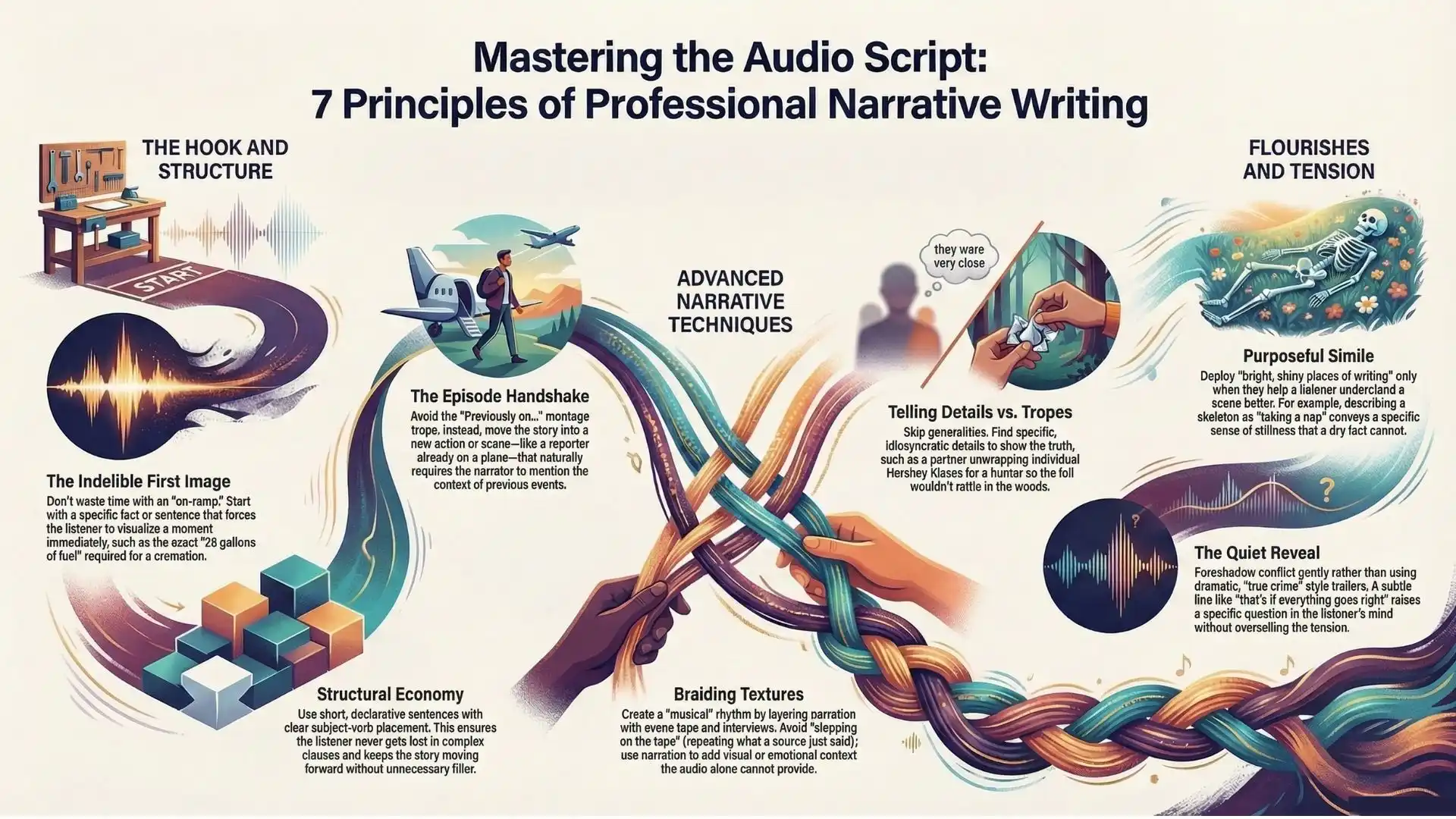
- The Indelible First Image: Don’t start with a summary. Start with a sentence that forces the listener to visualize a specific moment or fact immediately, like the “28 gallons of fuel” required for cremation.
- Structural Economy: Use short, declarative sentences. Avoid the “on-ramp” of introductory sentences that don’t move the plot. Place the subject and verb clearly to ensure the listener never gets lost.
- The Episode Handshake: Avoid the “Previously on…” montage. Move the story into a new scene or action that naturally requires the narrator to mention the context of the previous episode.
- Telling Details vs. Tropes: Skip generalities like “they were very close.” Find the specific, idiosyncratic detail—like unwrapping Hershey Kisses or a muzzleloader kit that required assembly—to show the truth of a situation.
- Braiding Textures: Don’t just “step on the tape” by repeating what a source says. Use narration to add visual details or emotional context that the audio alone cannot provide, creating a “musical” rhythm.
- Purposeful Simile: Use “bright, shiny pieces of writing” only when they help the listener understand a scene better, such as a skeleton looking like it is “taking a nap” to convey a sense of stillness.
- The Quiet Reveal: Foreshadow conflict gently. A line like “that’s if everything goes right” is more effective than a dramatic, over-the-top trailer because it raises a specific question in the listener’s mind.